Fold, Fill, Repeat: The Honiton Advent Calendar That Doesn’t Get Thrown Away
There is a particular sound that comes with the first week of December: the crackle of a cardboard advent calendar being opened, followed by the small, disappointing rattle of a plastic tray that will be in the bin by Boxing Day. In 2026, plenty of Honiton households are looking for a countdown that feels a bit more considered — and a bit less disposable.
The good news is that you don’t need a sewing machine, a craft room or a spare weekend. A reusable advent calendar can be as simple as a sheet of thick card, a packet of envelopes and a handful of brass split pins. The paper shop is, rather conveniently, the place where all three tend to live.
Start with a base you can keep
The trick is to think of the calendar as a backdrop, not the whole event. A large sheet of recycled greyboard, a folded A3 card, or even a sturdy length of ribbon hung across a chimney breast will all do the job. If you want something more structured, choose a heavy card that will hold its shape when it is folded into pockets and stored flat for eleven months of the year.
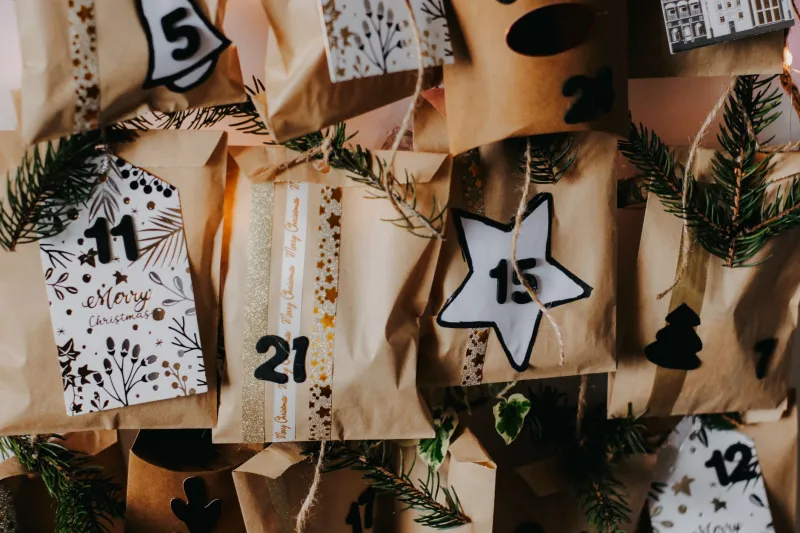
Paper pockets are the heart of it. Glassine envelopes, small brown paper bags, DL envelopes with the flaps folded down, or simple origami cups made from squares of wrapping paper all work. Number them with a rubber stamp, a white gel pen or a set of paper tags. Fix them with paper tape, cotton thread or those small brass split pins that look pleasingly old-fashioned and can be reused year after year.
The pocket that earns its keep
A refillable calendar only works if the pockets are easy to open and close. Clothes pegs are brilliant for this — wooden ones, not plastic — and they let you peg a pocket to a length of string in about three seconds. Paper bags can be folded over and held with a paper clip. Envelopes can be left unsealed so they can be refilled without tearing.
The point is not to make something that belongs in a magazine. The point is to make something that survives being opened by an excited seven-year-old at 6.45am. If a pocket tears, you replace one pocket, not the whole calendar. That is the quiet genius of the refillable approach.
What goes inside, without a plastic toy in sight
This is where local shops come into their own. A Honiton high street advent calendar can be filled with small, useful, edible or beautiful things that don’t arrive wrapped in a moulded plastic shell.
Think tiny pencils and sharpeners, seed packets for windowsill herbs, bookmarks, stickers, a pretty rubber, a folded joke, a recipe for ginger biscuits, a voucher for a walk to Honiton Bottom, or a handwritten note that says “your turn to choose the film”. Chocolate coins wrapped in foil are a classic for a reason. So are individually wrapped fudges from a local counter, though it is worth checking labels if you are filling a calendar for a classroom or for neighbours with allergies.
For adults, the same idea works with tea bags, nice soap, a scratch card, a tiny bottle of something local, or a promise of an hour’s babysitting. The best refillable calendars are not expensive; they are personal. A pocket that says “breakfast in bed on Sunday” costs nothing and gets remembered longer than a plastic novelty.
A classroom countdown that doesn’t cost the earth
Teachers in Honiton are already experts at making a little go a long way. A classroom calendar can be a string of paper pockets along a noticeboard, each containing a kindness prompt rather than a gift: “hold the door for someone”, “write a thank-you note to the caretaker”, “learn a new joke”. The children can make the pockets themselves from recycled paper, and the whole thing can be taken down and stored in a shoe box for next year.
It is also a gentle way to talk about waste without lecturing. A calendar that comes back is a small, practical lesson in looking after things.
Make it a High Street job, not an online one
One of the pleasures of a paper-shop advent calendar is that you can assemble it in an afternoon without waiting for a delivery. Honiton Paper Shop is the sort of place where you can pick up a pad of recycled card, a packet of glassine bags, a stamp set, a reel of paper tape, a few brass pins and a bag of chocolate coins in one go. You can hold the card and check it is thick enough. You can ask which envelopes fold best. You can leave with a project under your arm and a chat about whether it is too early for mince pies.
That is not a small thing. A refillable calendar is meant to be a tradition, and traditions are easier to keep when they are tied to a place you actually visit.
The quiet pleasure of refilling
By the time twelfth night arrives, the pockets are empty and the card is a little bent. Store it flat with the decorations, and next November it will be ready to go again. Add a new pocket each year if you like. Let the children write the numbers when they are old enough. Keep the notes that made everyone laugh.
A throwaway calendar is opened once and thrown away. A refillable one becomes part of the furniture of Christmas — a small, papery ritual that costs less than you think and says something rather lovely about the kind of Christmas you are trying to have.