Glue Stick Diplomacy: The Saturday Kit That Defuses Sunday-Night School Projects
There is a particular sort of silence that falls over a Honiton kitchen at about 8.45 on a Sunday night. It usually follows the words: “I’ve got to make something for school tomorrow.” The book bag is empty, the felt tips are dry, and somewhere in the recycling box there is a cereal packet that might, with a following wind, become a Roman villa.
We have all been there. The Sunday-night project panic is not a character flaw. It is a simple supply problem wearing a dramatic coat. And like most supply problems, it is much easier to solve on a Saturday morning than on a Sunday evening.
The little drawer that earns its keep
The hero of this story is not a grand craft cupboard. It is a shoebox, a tin, or a deep drawer with a label on it that says something unglamorous like “school bits”. Keep it somewhere you can reach without moving a slow cooker. The point is not to build an art department. The point is to buy yourself ten calm minutes when the deadline appears.
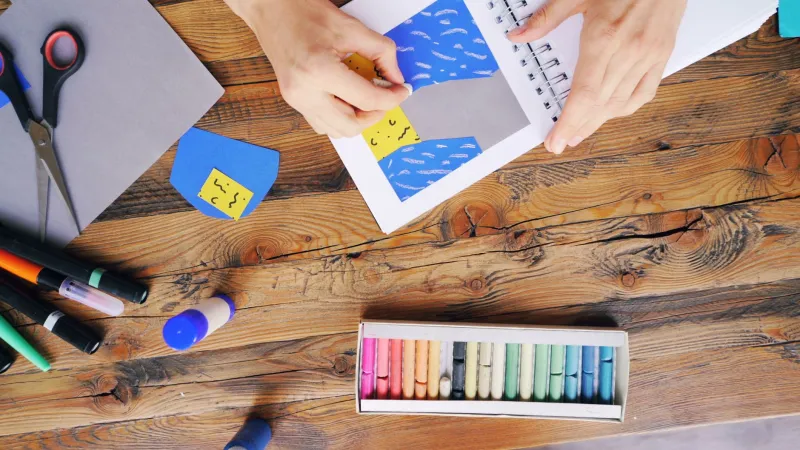
What goes in? Think of the things that get used up and never get replaced until the exact moment they are needed: glue sticks, a roll of sticky tape, a handful of pencils, a rubber that still works, a small pair of scissors that are not the good kitchen ones, and a ruler with numbers you can actually read. Add a few sheets of white A4 card, a pack of coloured paper, and one of those display folders with plastic wallets inside. If you have space, a couple of blank labels and a fine-liner pen will save more arguments than you would believe.
None of this needs to be expensive. It needs to be there. That is the whole trick.
Saturday morning, ten minutes, High Street
A Saturday morning potter into town is the ideal time to top up. Honiton is good at this sort of errand. You can pick up a pack of glue sticks, a bundle of coloured card and a display folder while doing the rest of your rounds, and you have the rest of the weekend in front of you. It is a far more pleasant experience than discovering at bedtime that the only glue in the house has gone solid and the only card is the back of an old birthday invitation.
When you are buying, think about the projects that actually come home. In November, it is often something topic-based: a poster about the Romans, a leaf collage, a few facts about a book, a model of a Tudor house made from a cardboard box. In the spring, it might be a photograph on card, a weather chart, or a “all about me” sheet that needs a picture of a pet. The kit does not need to cover every possibility. It just needs to cover the frantic ones.
What actually gets used
The useful things are rarely the fancy things. A glue stick is worth more than a hot-glue gun in a house where the project is due in the morning. A pack of coloured card beats a drawer full of tiny embellishments. A display folder is the quiet hero of the whole operation: it keeps loose sheets from becoming a sandwich in the book bag, and it makes a last-minute project look as if someone had planned it since half term.
It also helps to keep a small “making” box separate from the general household stationery. The good stapler can stay in the office. The school scissors can live with the school bits. That way, nobody has to negotiate a hostage release at 9pm.
If you have a child in Reception or Year 1, add a few large sheets of paper and some chunky crayons. If you have someone further up the school, add a couple of black fineliners, a small set of coloured pencils, and a spare USB stick if the homework sometimes involves a computer. Nothing too clever. Nothing too precious.
The Sunday-night ten-minute fix
So the moment arrives. The project has been remembered. You go to the drawer, not the car keys. You lay out a sheet of card, the glue stick, the scissors and the coloured paper. You put an old cloth or a piece of newspaper down. You make a cup of tea. The child does the cutting. You hold the ruler. Nobody has to drive anywhere.
That is the real value of the Saturday kit. It does not turn a child into a willing project-maker at bedtime. It does not banish the last-minute realisation. It simply removes the horrible bit where the whole thing depends on a shop being open and a parent being free to go to it.
And if you do find yourself short of something, the paper shop is usually a friendlier stop than a supermarket run. You can buy a single sheet of card, a glue stick, or a folder without committing to a multipack the size of a small suitcase. You can also ask a sensible question and get a sensible answer, which is not something a self-service till has ever managed.
A small habit, not a big project
Keep the drawer topped up at the start of each term. Chuck out the dried-up glue sticks. Rescue the ruler from the bottom of the book bag. Add a new pack of coloured paper when the old one has been reduced to a handful of pink offcuts. It takes five minutes and saves an evening.
The Sunday-night project panic will still visit now and then. It is part of family life, like lost PE socks and letters that never make it out of the bag. But with a modest stash in a drawer and a Saturday-morning top-up, it becomes a small, solvable thing rather than a full-scale emergency. And in a busy house, that is worth more than any amount of fancy craft equipment.
So next time you are in town on a Saturday, add a pack of glue sticks to the list. Future you, standing in the kitchen at 8.45 on a Sunday, will be very grateful.